The Credit Score Overhaul for FICO score when buying a home
Goodbye Classic FICO? How the 2026 Mortgage Credit Score Overhaul Helps More Buyers Qualify
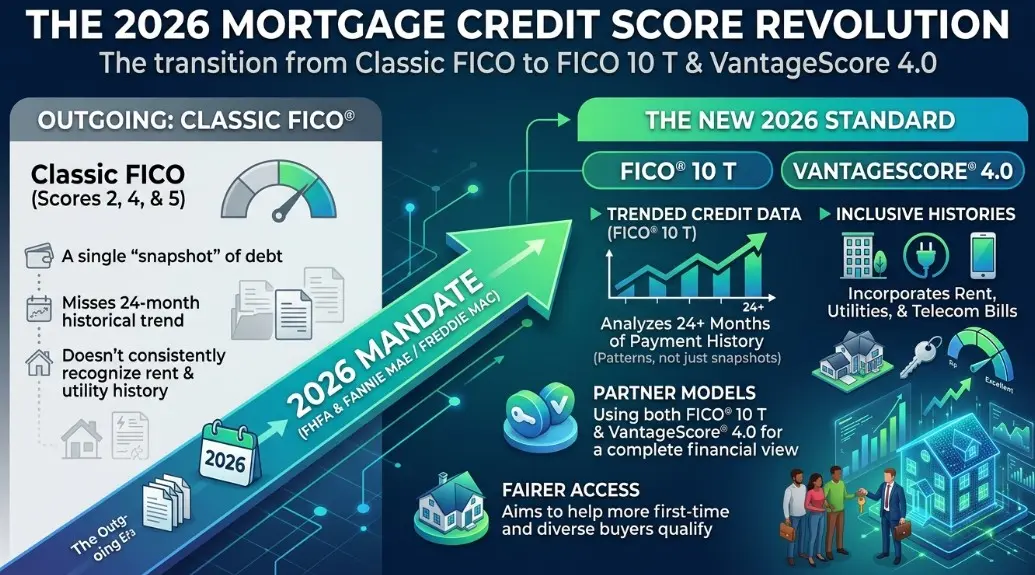
For more than two decades, a single algorithm—known in the mortgage industry as "Classic FICO"—acted as the ultimate gatekeeper for conventional home loans. It didn’t matter if the consumer credit score on your banking app said 760; when a mortgage lender pulled your tri-merge report, that older FICO model often produced a very different number based on a single, static snapshot in time.
In the fall of 2026, the mortgage industry rolled out its biggest credit scoring modernization in a generation. Following a mandate from the Federal Housing Finance Agency (FHFA), Fannie Mae and Freddie Mac officially expanded VantageScore 4.0 to all conventional lenders in September 2026—and unified their loan-level pricing grids on October 1, 2026.
Here is what changed behind the scenes in underwriting, and why it is great news for today’s homebuyers.
Snapshot vs. Trended Data: Why VantageScore 4.0 Is Different
The biggest flaw with the older Classic FICO model was that it judged your creditworthiness based on a single day’s snapshot. If you put $15,000 of business expenses or travel on a credit card and your lender pulled your credit two days before your statement auto-paid in full, your score could plummet due to "high utilization"—even if you hadn't paid a dime of interest in ten years.
VantageScore 4.0 fixes this by using trended credit data alongside alternative payment history:
-
Rewarding "Transactors" Over "Revolvers": Instead of looking at a single month’s balance, VantageScore 4.0 looks at up to 24 months of payment patterns. It can tell the difference between a borrower who carries high-interest debt month-to-month and a responsible borrower who puts heavy expenses on a card and pays it off in full every cycle.
-
Counting Rent, Utilities, and Telecom: For the first time in mainstream conventional lending, VantageScore 4.0 incorporates reported on-time rent, utility, and cell phone payments into its scoring algorithm.
-
More Forgiving on Medical Collections: The modern model ignores paid medical collections and places significantly less weight on unpaid medical debt compared to older scoring models.
The October 2026 "Unified Pricing" Breakthrough
While Fannie Mae began piloting VantageScore 4.0 earlier in the year, two landmark updates in fall 2026 made it an everyday reality for buyers:
-
Open to All Lenders (September 2026): Fannie Mae and Freddie Mac opened VantageScore 4.0 delivery to all approved lenders without requiring special prior approval, leading nearly 40% of Desktop Underwriter (DU) applications to include VantageScore 4.0 by autumn.
-
Unified Pricing Grid (October 1, 2026): Fannie Mae eliminated separate pricing tables for different credit models. Today, a 740 VantageScore 4.0 receives the exact same Loan-Level Price Adjustment (LLPA) and interest rate tier as a 740 Classic FICO score. (Note: Lenders cannot mix-and-match models on the same loan; all borrowers on an application must be evaluated under either Classic FICO or VantageScore 4.0.)
Who Benefits the Most?
This shift is a massive advantage for self-employed borrowers who run heavy monthly business expenses through personal credit cards and pay them off, as well as first-time homebuyers who have a pristine history of paying high Los Angeles rents on time but only have one or two traditional credit lines.
Want to see where your credit stands under the new 2026 rules? Reach out today for a strategic pre-approval review so we can evaluate which scoring model puts you in the best rate tier before you shop for a home.
Categories
Recent Posts









GET MORE INFORMATION