Legacy Wealth Is Quietly Reshaping Who Owns Homes in Los Angeles
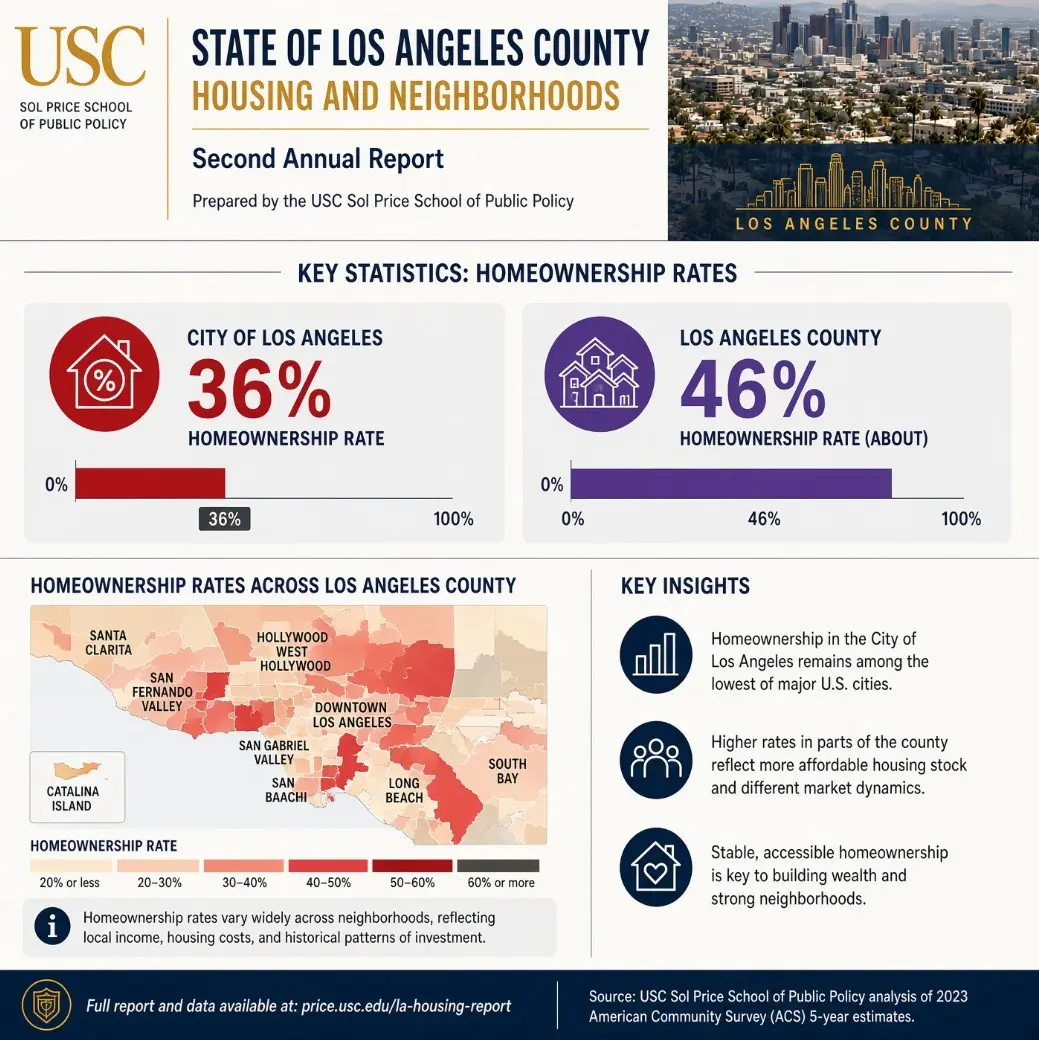
Los Angeles has long been one of the hardest places in America to buy a house. The latest data from USC’s Lusk Center for Real Estate makes the barriers clearer—and more personal—than most headlines suggest.
The second annual State of Los Angeles County Housing and Neighborhoods report shows the City of Los Angeles homeownership rate at 36 percent. Los Angeles County sits at about 46 percent. California is around 56 percent. The national figure is roughly 65 percent. Nearly half of county homeowners have lived in the same house for at least 20 years. Median home values in the city run close to 12 times median household income; the county ratio is nearly 10 times. The national ratio is about 4 to 1.
Those numbers are familiar. The more striking finding involves younger owners.
Among homeowners under age 45, the share who own free and clear of a mortgage rose 27 percent over the past decade. These mortgage-free younger households report lower average incomes—about $163,000 versus $223,000 for those carrying mortgages. USC researchers interpret the pattern as evidence that more young households are living in homes purchased and paid off by earlier generations. California already records a higher share of property transfers through inheritance than the national average. In short, a meaningful slice of younger ownership is arriving through family transfer rather than traditional purchase.
This is the quiet story underneath the ownership decline. The market is not simply expensive. It is increasingly stratified by whether a household already holds or can inherit paid-off equity.
What the Numbers Mean on the Ground
Long-term owners hold substantial equity. That creates stability in established neighborhoods but also reduces turnover. Inventory stays tight. First-time and move-up buyers without family capital face steeper barriers. High earners are staying in the rental market longer, which keeps pressure on rents even as some new supply appears.
Housing production data in the same report offers limited relief. Between 2018 and 2025, smaller cities such as Rolling Hills Estates, Duarte, and Hidden Hills led per-capita unit production. Los Angeles, Monrovia, and West Hollywood followed. Timelines from permit to certificate of occupancy have lengthened: roughly 22 months for single-family homes, 18 months for two- to four-unit buildings, and 37 months for larger multifamily projects. Affordable multifamily projects finished about one month faster than market-rate ones on average. Accessory dwelling units continue to set records and now account for a large share of new certified units, yet they do not fully substitute for traditional ownership opportunities.
The post-fire recovery picture is uneven. Altadena has seen more completed homes and ADUs relative to Pacific Palisades, where new construction has lagged demolitions. Palisades Village, the retail center developed by Rick Caruso, reopened in mid-August 2026 after roughly $100 million in restoration work. Private firefighting efforts helped limit damage to the center itself. Separately, Johnny Buss purchased a cleared 15,000-square-foot lot at 860 Via de la Paz for about $7 million. That site previously held a larger office-retail building destroyed in the fire. These are visible markers of capital returning, even as many individual homeowners continue navigating insurance, permitting, and rebuild costs.
On the policy side, Malibu and Pasadena settled litigation with YIMBY Law over local restrictions on Senate Bill 9 projects in high fire-severity zones. Both cities agreed to resume processing applications that allow lot splits and additional units on single-family parcels. That removes one temporary barrier in fire-affected areas, though broader questions about density, infrastructure, and evacuation routes remain contested.
Practical Implications for Buyers and Sellers
For buyers without inherited equity, the path is narrower but not closed. Strategies that improve the numbers include targeting properties that support accessory units or limited multifamily configurations, exploring emerging production corridors with relatively stronger per-capita delivery, and treating longer hold periods as realistic rather than temporary. The data also suggest that high-income renters are a growing segment; some of them will eventually convert to ownership when rates or inventory shift.
Sellers of long-held homes often sit in strong equity positions. That can support flexible timing, but it also means buyers may need creative financing or family assistance to clear the affordability gap. In fire-recovery zones, vacant lots and rebuild opportunities are attracting both institutional and individual capital. Pricing, permitting speed, and insurance availability will continue to differentiate winners from stalled projects.
The inheritance pattern highlighted by USC is not temporary. California’s high cost structure and aging ownership base make intergenerational transfers a structural feature. Families that plan for it—through clear estate structures, property management, or intentional equity sharing—gain an advantage. Those who do not face a steeper climb.
Los Angeles will not suddenly become an easy ownership market. The combination of constrained supply, long construction timelines, and concentration of paid-off equity among longer-term owners keeps the barrier high. Yet the same data show pockets of production, policy adjustments after the fires, and capital returning to damaged neighborhoods. For households prepared to work with those realities rather than against them, opportunities still exist. The households best positioned to seize them will treat ownership as a multi-generational project rather than a single transaction.
Categories
Recent Posts






GET MORE INFORMATION